
Quality is more than checking whether a service has been delivered correctly. In a modern business environment, quality is about having the right systems, people and processes in place to consistently deliver value to customers.
For businesses operating in industries such as maritime, logistics, transportation and supply chain management, this is particularly important. Daily operations involve multiple people, processes, equipment, customers, suppliers and regulatory requirements. A weakness in one area can affect the entire chain. This is where quality management principles become important.
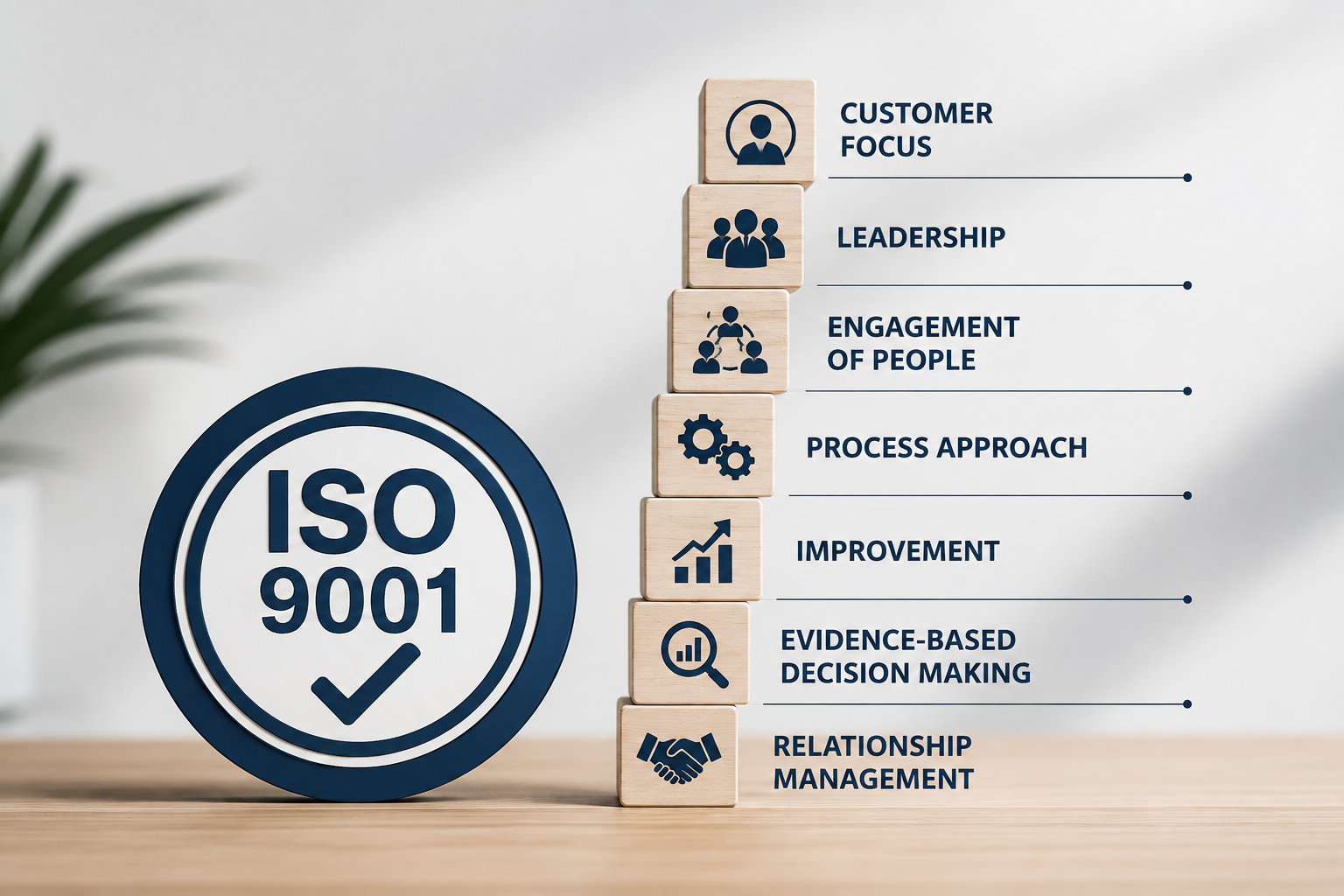
The International Organization for Standardization (ISO) identifies seven quality management principles that provide a foundation for organizations seeking to improve performance and consistently meet customer expectations. These principles are customer focus, leadership, engagement of people, process approach, improvement, evidence-based decision making and relationship management.
Although these principles are commonly associated with ISO 9001, it is important to note that the seven principles are defined within the ISO 9000 family and provide the foundation on which ISO 9001’s quality management system requirements are built. So, what do these seven principles actually mean, and how can businesses apply them?
1. Customer Focus
At the centre of quality management is the customer. A business may have excellent internal processes, modern equipment and highly qualified employees, but if it consistently fails to understand or meet customer requirements, its quality system is not achieving its purpose.
The customer focus principle encourages organizations to understand customer needs, meet their requirements and anticipate changing expectations. For a service-based business, this could mean paying attention to:
- Service reliability
- Response times
- Communication
- Accuracy
- Safety
- Customer complaints
- Delivery timelines
- Consistency of service
In a maritime or logistics environment, customer focus can be seen in areas such as cargo handling, equipment availability, vessel operations, transportation and warehousing. Customers depend on these activities being carried out efficiently and safely because delays or errors in one part of the operation can have consequences further along the supply chain.
Customer feedback should therefore not simply be treated as a complaint-management exercise. It can provide useful information about where processes are working and where improvements may be needed. ISO identifies customer focus as a central quality management principle because maintaining customer confidence and responding to current and future customer needs contributes to long-term organizational success.
2. Leadership
Leadership plays an important role in creating an environment where quality becomes part of the organization’s culture. Effective leadership provides direction, establishes priorities and ensures that employees understand what the organization is trying to achieve.
This means management should do more than establish policies. Leaders need to demonstrate through their decisions and actions that quality, safety, customer satisfaction and continuous improvement are genuine organizational priorities. In practical terms, leadership can involve:
- Setting clear quality objectives
- Providing adequate resources
- Communicating expectations
- Supporting employees
- Encouraging collaboration between departments
- Addressing recurring problems
- Reviewing performance
- Taking corrective and preventive action where necessary
For an organization with several operational departments, strong leadership also helps ensure that departments are not working in isolation. When leadership establishes a clear direction, employees are more likely to understand how their individual responsibilities contribute to the wider objectives of the organization.
3. Engagement of People
No quality management system can succeed without people. Employees are the people who operate equipment, communicate with customers, process documentation, manage cargo, coordinate logistics, maintain facilities and perform the countless daily activities that keep an organization running.
The engagement of people principle recognizes that competent, empowered and engaged employees are essential to an organization’s ability to create and deliver value. Employee engagement goes beyond simply having staff present at work. Employees should understand:
- What is expected of them
- How their work affects other departments
- Why quality matters
- What standards they are expected to meet
- How to report problems
- How they can contribute to improvements
Organizations can encourage engagement through appropriate training, communication, recognition, teamwork and opportunities for employees to contribute ideas. This is particularly important in operational environments where employees may be the first to identify a problem or inefficiency.
The person working directly with a process every day may notice a recurring issue long before it appears in a management report. Creating an environment where employees can raise these issues and contribute solutions can therefore become an important part of quality improvement.
4. Process Approach
Businesses are made up of interconnected activities. A customer’s request may trigger several different processes involving customer service, operations, logistics, documentation, equipment, finance and administration.
The process approach encourages organizations to understand these activities as interconnected processes rather than treating each department as a completely separate unit. ISO explains that managing activities as interrelated processes helps organizations achieve more consistent and predictable results.
Consider a simple logistics operation. A customer requirement may lead to:
Customer request → Planning → Resource allocation → Equipment/Personnel → Operations → Documentation → Delivery/Completion → Customer feedback
If one stage is poorly coordinated, the entire process can be affected. For example, equipment may be available but personnel may not be properly scheduled. Personnel may be available but the required documentation may not be completed. Or an operational activity may be completed but information may not be properly communicated to the next department.
Looking at the organization through a process approach helps identify these connections. It also makes it easier to identify bottlenecks, duplication, delays and areas where responsibilities are unclear.
5. Improvement
A quality management system should not remain static. Markets change. Customer expectations change. Technology changes. Regulations change. Operational challenges change. Organizations therefore need to continually look for ways to improve their processes and performance.
Improvement is the fifth quality management principle and encourages organizations to maintain an ongoing focus on making things better. Improvement does not always mean introducing a major new system. Sometimes it may involve a relatively small change, such as:
- Reducing unnecessary paperwork
- Improving communication between departments
- Reducing equipment downtime
- Improving staff training
- Updating an outdated procedure
- Reducing operational delays
- Improving record keeping
- Addressing the root cause of recurring problems
The important thing is that organizations learn from experience and use those lessons to improve future performance. This creates a cycle:
Identify → Analyse → Improve → Monitor → Learn → Improve again
That mindset is at the heart of continual improvement.
6. Evidence-Based Decision Making
Good decisions should be based on more than assumptions. The evidence-based decision-making principle emphasizes the importance of analysing and evaluating reliable data and information when making decisions. ISO notes that decisions based on evidence are more likely to produce the desired results. For businesses, useful evidence can come from many sources, including:
- Customer feedback
- Operational reports
- Performance indicators
- Incident reports
- Audit findings
- Equipment records
- Financial information
- Employee feedback
- Complaints
- Delivery or turnaround times
For example, if a business believes that operational delays are caused by insufficient manpower, it should ideally examine relevant records before making a decision. The data may reveal that the real issue is actually equipment downtime, poor scheduling or communication between departments.
Evidence helps organizations move from “we think this is the problem” to “the information shows us where the problem is.” That distinction can lead to better decisions, better resource allocation and more effective solutions.
7. Relationship Management
Businesses do not operate alone. They depend on relationships with customers, suppliers, contractors, employees, regulators, service providers and other stakeholders. The seventh principle, relationship management, recognizes that organizations need to manage important relationships in order to achieve sustained success.
For a maritime and logistics company, this principle is particularly relevant because successful operations often depend on coordination between multiple parties. A single operation can involve relationships between:
- Customers
- Terminal operators
- Port authorities
- Shipping companies
- Equipment providers
- Logistics providers
- Contractors
- Employees
- Regulatory bodies
- Other service partners
Strong relationships can improve communication, coordination and reliability. However, relationship management is not simply about maintaining good relationships. It is also about establishing clear expectations, communicating effectively, monitoring performance and addressing issues when they arise.
When organizations and their partners understand their respective responsibilities, operations are more likely to run smoothly.
How the Seven Principles Work Together
The seven ISO 9001 principles should not be viewed as seven completely separate activities. They are interconnected.
- Customer focus tells an organization where value needs to be delivered.
- Leadership provides direction.
- Engagement of people ensures employees are involved in achieving the organization’s objectives.
- Process approach connects the activities required to deliver results.
- Improvement ensures the organization continues to get better.
- Evidence-based decision making helps management make informed choices.
- Relationship management strengthens the connections with the people and organizations that contribute to the business.
ISO emphasizes that the principles are not arranged in an order of priority. Their relative importance can vary depending on the organization and its circumstances. Together, however, they provide a practical foundation for building a culture where quality is everyone’s responsibility.
Why Quality Management Matters in Maritime and Logistics
In industries where operations involve cargo, vessels, equipment, transportation, warehousing and multiple stakeholders, consistency is critical. A small operational failure can potentially result in delays, damaged cargo, equipment downtime, additional costs or customer dissatisfaction.
A strong quality management approach helps organizations create clearer processes, identify risks, monitor performance and continually improve how work is done. ISO states that quality management principles can help organizations improve performance, reduce waste, prevent errors, support competitiveness and enhance customer satisfaction.
For companies operating in the maritime and logistics space, these outcomes are particularly valuable because efficiency and reliability are closely connected to the quality of everyday operations.
Quality Is More Than a Certificate
It is easy to think of ISO certification simply as a certificate displayed on an office wall. In reality, effective quality management is about what happens after the certificate is issued.
It is reflected in how employees perform their responsibilities, how departments communicate, how problems are addressed, how customers are treated and how management responds to opportunities for improvement.
ISO 9001 provides requirements for establishing, implementing, maintaining and continually improving a quality management system. The real value of quality management, therefore, comes from applying its principles to everyday work.
For an organization committed to delivering dependable services, quality should not be a once-a-year audit exercise. It should be part of the way the organization operates every day.
Building a Culture of Quality
Ultimately, quality management is about creating an organization where everyone understands that the quality of the final result depends on the quality of the processes that produce it. From management and supervisors to operational teams and support departments, every employee has a role to play.
The seven quality management principles provide a useful framework for that journey:
- Customer Focus
- Leadership
- Engagement of People
- Process Approach
- Improvement
- Evidence-Based Decision Making
- Relationship Management
When these principles are integrated into everyday operations, they can help organizations build stronger processes, make better decisions, improve customer confidence and create a culture of continual improvement.
It is also important to remember as staff of the company that quality is not just the responsibility of one department. It is a responsibility shared across the entire organization in our everyday work activities.