
“Quality is the degree to which a set of inherent characteristics fulfils requirements.”
— ISO 9000. At Micura, those requirements come from our customers, our regulators, and ourselves.
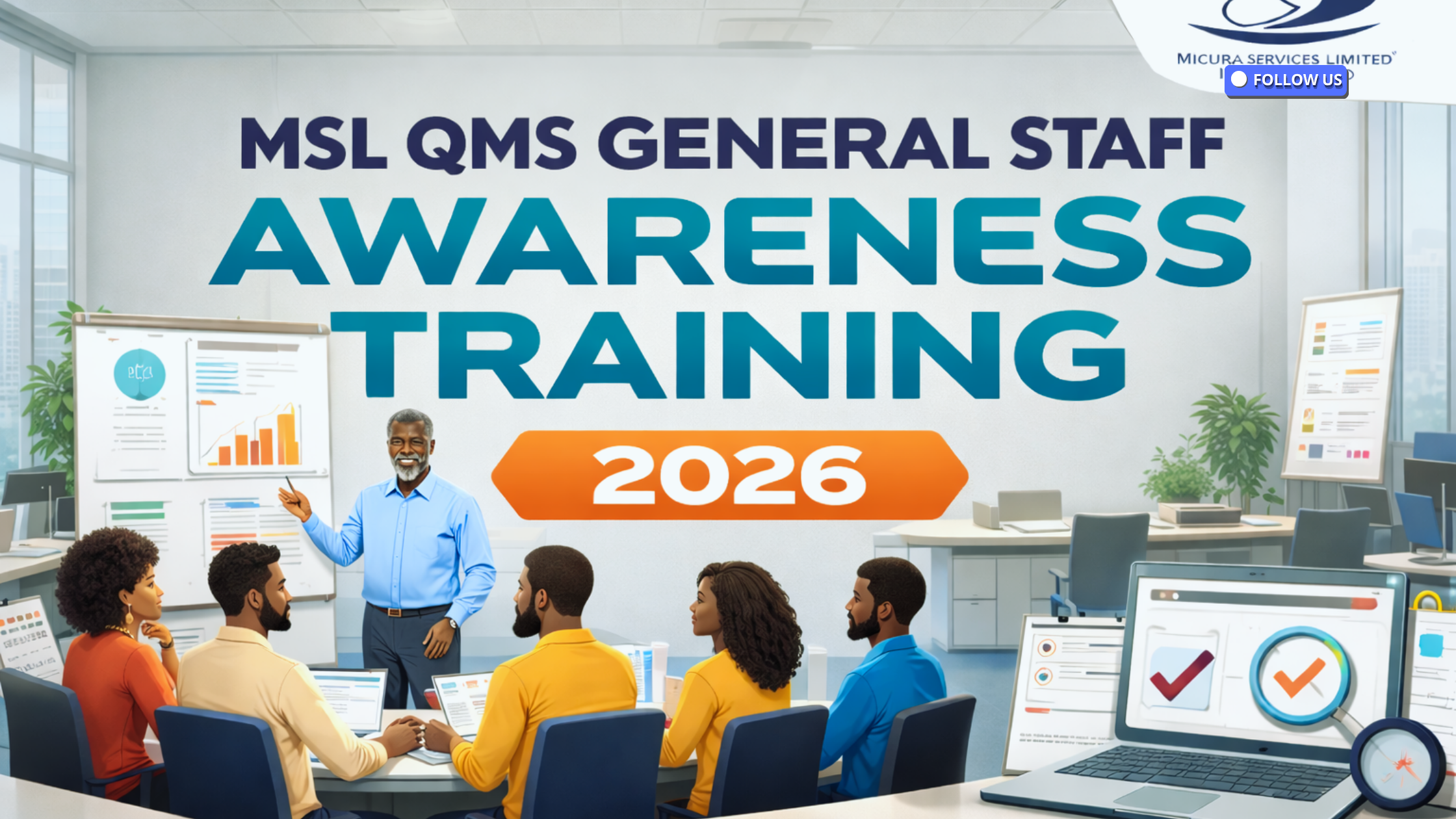
On Wednesday, 15 April 2026, Micura Services Limited hosted a General Staff Awareness Training on the ISO 9001:2015 Quality Management System (QMS), facilitated by our consulting partners, Fibalab Services Limited. The session brought together staff from across the organisation for an immersive day of learning, reflection, and renewal of our collective commitment to quality excellence.
Quality as we learned is not a department, rather, it is a mindset, and sustaining that mindset requires ongoing investment in people. The 2026 Staff Awareness Training was designed to deepen every team member’s understanding of what quality means in a practical, day-to-day context, how our Quality Management System supports that goal, and what each of us must do to keep Micura Services Limited at the forefront of service delivery excellence.
The training began with a foundational exploration of what quality truly means, and who is responsible for it. Participants learned that quality is not a single, fixed definition but a multi-dimensional concept that includes:
- Fitness for Use
A product or service is quality if it is fit for the purpose for which it was designed and delivered.
- Conformance to Requirements
Quality means meeting specified standards — no more, no less. Defects arise from a failure to comply.
- Meeting Requirements
The extent to which a product or service satisfies customer, regulatory, and internal organisational requirements.
A key insight from the session was that the quality of a job is ultimately determined by the person doing the job. This is a powerful reminder that quality is not just a management issue but it lives in the hands and decisions of every employee, every single day.
The training also clarified who determines quality standards: regulatory and statutory bodies carry the greatest weight (approximately 70%), followed by the organisation’s own QMS (20%), and customers themselves (10%). Understanding this hierarchy helps us align our processes with the right priorities.
A major focus of the training was ISO 9001:2015, the globally recognized standard for Quality Management Systems (QMS).
Staff were guided through:
- The meaning and importance of ISO standards
- The evolution of ISO 9001 over the years
- How QMS helps organizations deliver consistent, high-quality services
The training highlighted that a functional QMS ensures that:
- Processes are clearly defined and documented
- Roles and responsibilities are well structured
- Performance is monitored and improved continuously
This structure not only enhances efficiency but also builds trust with clients and stakeholders. Being ISO 9001:2015 certified places Micura Services Limited among organisations that demonstrate credibility, competence, and global best practice.

One of the most impactful portions of the training covered the Plan-Do-Check-Act (PDCA) Cycle which is the operational backbone of ISO 9001:2015. Also known as the Shewhart Cycle, PDCA is a systematic approach to achieving and improving quality across all our processes.
- Plan: Establish objectives and processes needed to deliver results aligned with customer requirements, company policies, and identified risks and opportunities.
- Do: Implement what was planned. This covers operational execution providing the right resources, competencies, and controls to deliver services consistently.
- Check: Monitor and measure processes and services against policies and objectives. Record results and ask: are we doing the work as planned?
- Act: Take actions to continually improve process performance. This is where learning happens and understanding how we can do better next time?
The PDCA cycle is not a one-time activity; it is a continuous loop that drives ongoing improvement across everything Micura Services Limited does.
The 7 Principles of Quality Management
ISO 9001:2015 is built on seven foundational principles that guide how organisations approach quality. These principles were discussed in depth during the training:
- Customer Focus
- Leadership
- Engagement of People
- Process Approach
- Improvement
- Evidence-Based Decision Making
- Relationship Management
Of these, Customer Focus was emphasised as the cornerstone of QMS; that is our ability to understand, meet, and exceed what our clients expect is what determines our long-term success. Every other principle ultimately supports this goal.
Another significant focus of the training was risk-based thinking, which is one of the key innovations of the ISO 9001:2015 revision. This approach enables Micura Services Limited to proactively identify factors that could affect our QMS performance, whether positively or negatively.
Rather than waiting for problems to emerge, risk-based thinking empowers us to put preventive controls in place, minimise negative impacts, and seize opportunities as they arise. The eight-step process shared during training included:
Identify the Risks — What could go wrong in our processes?
Apply Risk-Based Thinking — Use structured analysis for each process area.
Balance Risk and Opportunity — Every risk has a corresponding opportunity worth pursuing.
Analyse and Prioritise — Determine what is unacceptable and must be addressed first.
Plan Actions — Decide whether to avoid, eliminate, or mitigate each risk.
Implement the Plan — Take decisive action.
Check Effectiveness — Does the action actually work?
Record, Learn and Improve — Capture lessons and embed them into future practice.
Staff were also given practical guidance on how to approach an upcoming surveillance audit like reviewing QMS documentation and SOPs; conducting internal audit processes; verifying corrective actions have been completed; performing management reviews; ensuring records and evidence are in order; and fostering a positive, open mindset because audits are about assurance and improvement, not blame. A well-organised, clean, and safe workplace also makes a strong statement about our operational discipline.

Competence, Work Ethic, and Customer Care
Perhaps the most personally resonant part of the training shifted focus from systems to people. The facilitator drove home that no QMS succeeds without competent, committed, and caring people. The training outlined five dimensions of competence: knowledge, skills, abilities, behaviour, and certifications or credentials. But competence alone is not enough. Staff must also be committed to their roles and compatible with the organisation’s culture and values.
Participants were encouraged to embody the traits of exceptional employees: being self-managed, prioritising work effectively, staying goal-oriented, remaining patient and hardworking, and bringing genuine passion to every task. These qualities directly influence the quality of output that reaches our clients.
The training reinforced that satisfied customers are not just good for business — they are the business. Key customer care principles shared included assigning clear responsibility for client communication, consistently fulfilling customer requirements, handling complaints with urgency and professionalism, and creating authentic, emotional connections with clients.
As the training put it: if your service is distinctive and desirable, customers will always come and customers will stay.
The 2026 QMS Staff Awareness Training was more than a compliance exercise. It was a renewal of Micura Services Limited’s founding promise to deliver services that are excellent, consistent, and worthy of our clients’ trust.
Every member of staff who participated left with a clearer understanding of their role in the quality chain, from the front desk to the field, from management to operations. Quality is not an abstract concept. It is every report filed correctly, every client call answered professionally, every deadline met, and every problem resolved with care.
We extend our gratitude to Fibalab Services Limited for their expert facilitation, and to all Micura staff who engaged actively and brought their best energy to the session. As we continue on our ISO 9001:2015 journey, let us remember: Happy staff make a happy organisation; and a happy organisation delivers quality that keeps customers coming back.

“How acceptable is the quality of your work to your clients”? Simple as it sounds, this question encapsulates the entire spirit of ISO 9001:2015 strategically placing the customer at the very centre of everything we do.
For further understanding of the training, Kindly click on the download PDF button below to download the ISO QMS General Staff Awareness 2026 handout