
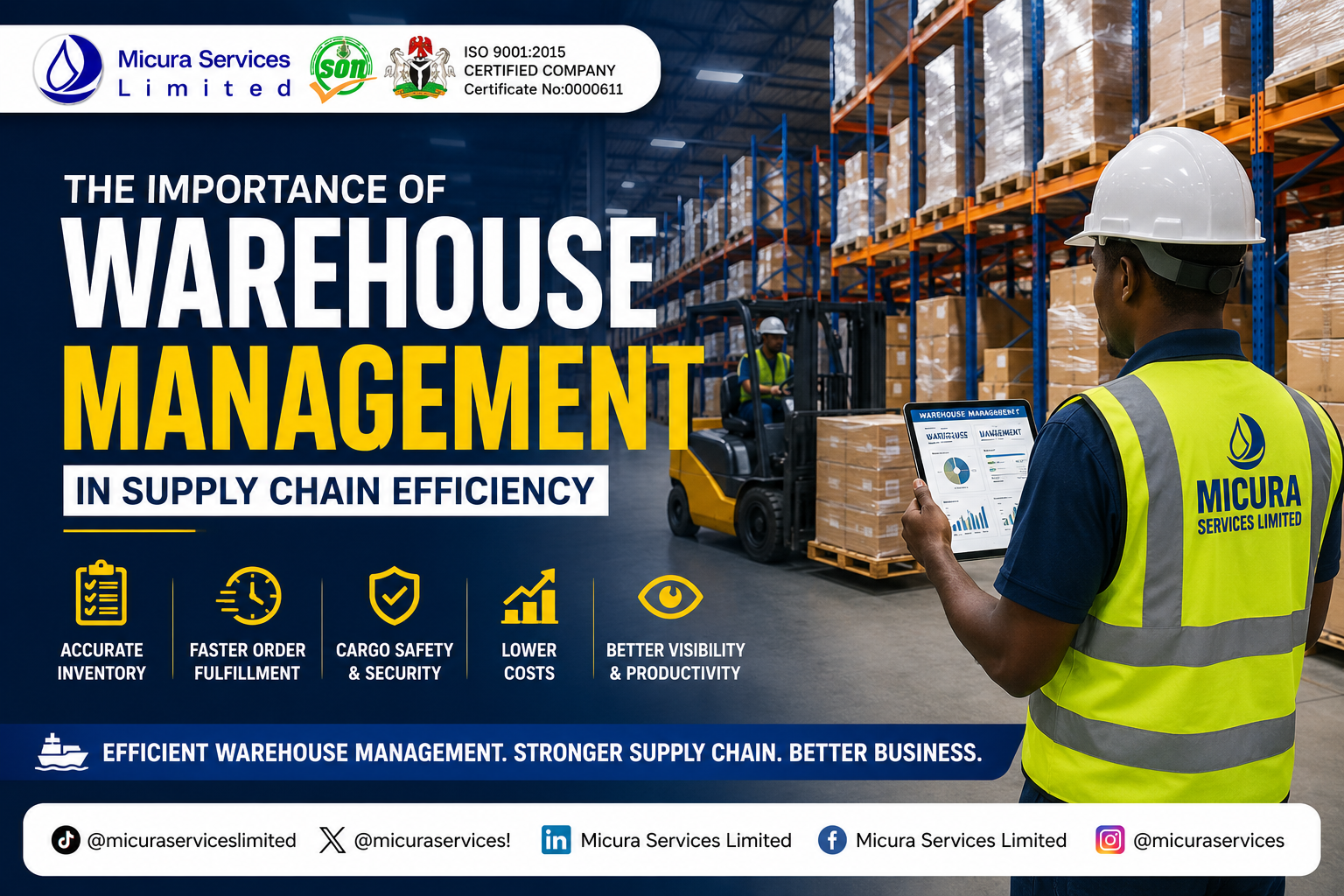
In today’s fast-moving business environment, efficient supply chain management has become more than a competitive advantage, it’s a necessity. While transportation and cargo handling often receive much of the attention, one critical component that determines the success of the entire supply chain is warehouse management.
Warehouses are far more than storage facilities. They serve as strategic hubs where goods are received, inspected, stored, managed, and dispatched. When warehouse operations are efficient, businesses experience faster deliveries, lower operational costs, improved customer satisfaction, and greater visibility across the supply chain.
At Micura Services Limited (MSL), we understand that effective warehouse management plays a significant role in ensuring cargo moves seamlessly from the port to its final destination.
Warehouse management refers to the planning, organization, and control of daily warehouse operations. It covers every stage of inventory movement, including:
Receiving cargo
Inspection and documentation
Proper storage and stacking
Inventory tracking
Order processing
Picking and packing
Dispatch and distribution
The objective is to ensure the right products are available, in the right condition, at the right time, while minimizing operational costs.
Knowing exactly what inventory is available prevents costly errors such as overstocking, understocking, and misplaced goods. Accurate inventory records enable businesses to:
Meet customer demand consistently
Reduce inventory losses
Improve procurement planning
Minimize unnecessary storage costs
Reliable inventory management also helps businesses make informed operational decisions.
Customers expect quick and reliable deliveries. A well-organized warehouse allows staff to locate, pick, package, and dispatch products efficiently, significantly reducing processing times. This leads to:
Faster deliveries
Increased customer satisfaction
Better service reliability
Stronger business reputation
Poor warehouse organization often results in wasted time, duplicated efforts, damaged products, and higher labour expenses. Efficient warehouse management helps reduce:
Labour costs
Storage inefficiencies
Product damage
Inventory shrinkage
Equipment downtime
Lower operational costs directly improve business profitability.
Warehouses handle valuable cargo that requires careful storage and monitoring. Safe storage practices preserve cargo quality while reducing financial losses. Proper warehouse procedures help protect goods from:
Damage
Theft
Contamination
Weather exposure
Improper handling
Modern warehouse operations provide businesses with real-time information about inventory levels and cargo movement. This improves decision-making across the entire logistics network. Greater visibility allows companies to:
Track inventory accurately
Monitor stock availability
Plan replenishment efficiently
Respond quickly to supply chain disruptions
An organized warehouse allows employees and equipment to work more efficiently. Clearly defined storage locations, optimized layouts, and standardized operating procedures reduce unnecessary movement and improve workflow. Higher productivity means more cargo can be handled within shorter periods without compromising quality.
Warehouse operations have evolved significantly through digital transformation. Modern warehouse management systems (WMS) help businesses automate and optimize daily operations through:
Barcode and QR code scanning
Real-time inventory tracking
Digital stock records
Automated reporting
Cargo location management
Performance monitoring
These technologies reduce human error while improving operational efficiency and accountability.
Every stage of the supply chain depends on efficient warehouse operations. Poor warehouse management creates delays that affect transportation, customer satisfaction, and business profitability. Conversely, when warehouse processes are well managed:
Cargo moves faster from ports to customers.
Transportation schedules improve.
Inventory remains accurate.
Delivery timelines become more reliable.
Overall supply chain performance improves.
At Micura Services Limited, warehouse management is an integral part of our end-to-end logistics solutions. By integrating warehousing with our stevedoring, logistics, and distribution services, we help clients streamline their supply chains and improve operational efficiency. Our warehousing operations are designed to support efficient cargo handling through:
Secure cargo storage
Professional inventory management
Organized stacking systems
Efficient cargo documentation
Timely dispatch coordination
Strict adherence to safety and quality standards
Warehouse management is much more than storing goods to us at MSL, it is the operational backbone of an efficient supply chain. Businesses that invest in organized warehouse processes benefit from lower costs, improved inventory accuracy, faster deliveries, and stronger customer satisfaction.
As supply chains become increasingly complex, effective warehouse management will continue to play a crucial role in helping businesses remain competitive and responsive to market demands. Micura Services Limited remain committed to delivering reliable warehouse and logistics solutions that keep cargo moving safely, efficiently, and on schedule.
WhatsApp us